ABOUT AMERICA250
America250 is a nonpartisan initiative working to engage every American in commemorating the 250th anniversary of our country. This multi-year effort, from now through July 4, 2026, is an opportunity to pause and reflect on our nation’s past, honor the contributions of all Americans, and look ahead toward the future we want to create for the next generation and beyond.
The themes of America250 bear resemblance to the fundamental question that Noah Webster put to his fellow citizens following the American Revolution, and would continue to help define throughout his lifetime: “What does it mean to be an American?”
The Noah Webster House & West Hartford Historical Society is honored to celebrate this nationwide initiative by offering America250-themed programming beginning in 2024.
America250 Presentations Supported By:



Before Salem: Witch Hunting in the Connecticut River Valley
Wednesday, October 29, 2025
6:30 p.m.

Decades before the Salem Witch trials, 11 people were hanged as witches in the Connecticut River Valley. The advent of witch hunting in New England was directly influenced by the English Civil War and the witch trials in England led by Matthew Hopkins, who pioneered “techniques” for examining witches. This history examines the outbreak of witch hysteria in the Valley, focusing on accusations of demonic possession, and the role of the clergy.
This program is co-hosted by the Noah Webster House & West Hartford Historical Society, West Hartford 250, and the West Hartford Town Historian.
About The Presenter:
Dr. Richard S. Ross, is Professor Emeritus and former College Librarian at Trinity College, Hartford Connecticut. He holds an MA from Northeastern University, an MLS from Simmons College and a PhD from Boston College. He has taught at Boston College, Northeastern University, the University of New Hampshire, and Trinity College. He has held administrative Librarian positions at Northeastern University, the University of Massachusetts at Lowell, the University of New Hampshire and Georgetown University.
This America250 presentation is supported by Eversource Energy & The Rotary Club of West Hartford.
“Oh, How We Danced”
Wednesday, November 12, 2025
6:00 p.m.

Learn about how early American families passed the time with music and dancing. Enjoy a presentation of 18th-century dance music through songs, visuals, and readings. Guests will have the opportunity to then participate in a demonstration of a popular Country Dance, just as Noah Webster might have enjoyed!
About Fran Hendrickson:
Frances Cibel Hendrickson has devoted her life to preserving and sharing the music, dance, and culture of the 18th century. With her late husband, Charles Cyril Hendrickson, Fran brought these historical arts to modern audiences along the historic east coast of North America and Canada through performance, research, and publishing. The Hendrickson Group uncovered and republished hundreds of forgotten 18th-century dances, both tunes and instructions from original handwritten and printed sources. Today, Fran educates and delights audiences through music, dance instruction, and historical presentations.
This America250 presentation is supported by Eversource Energy & The Rotary Club of West Hartford.
Working for the Revolution: Patriot Women’s Lives During the War
Thursday, January 22, 2026
6:30 p.m.

The talk will explore how women contributed to the American Revolutionary effort politically, economically, intellectually, and even militarily. Using original sources like newspapers, court records, letters, and pension records, Dr. Hermes will show how Indigenous, Anglo-European, and African-descended women all helped to further the Patriot cause.
This program is co-hosted by the Noah Webster House & West Hartford Historical Society, West Hartford 250, and the West Hartford Town Historian.
About The Presenter:
Katherine Hermes is the publisher and executive director of Connecticut Explored magazine, a non-profit history publication produced for readers interested in Connecticut’s past. She is professor emerita of history at Central Connecticut State University, where she taught Early American history for 25 years. She has created and been involved with a number of digital public history projects, including Forgotten Voices of the Revolutionary War: People of Color and the Redding Encampment, 1778-1779.
This America250 presentation is supported by Eversource Energy & The Rotary Club of West Hartford.
Bristow: A Life Remembered

Thursday, February 19, 2026
6:00 p.m.
Tickets available now at: https://noahwebster.yapsody.com/event/index/857207/the-story-of-bristow
Bristow, sometimes spelled Bristol, was a resident of the West Division of Hartford (now West Hartford) in the mid to late 1700s. Regarded for his agricultural knowledge, he was enslaved by the Thomas Hart and Sarah Whitman Hooker family until 1755. Hooker family lore maintained that he was granted his freedom, but his manumission papers show that he purchased his freedom from Thomas Hart Hooker. Bristow lived with his former enslaver, Sarah Whitman Hooker, in his later life and rests in Old Center Cemetery on North Main Street, West Hartford. In 2004, West Hartford named its third middle school after Bristow, a colonial era resident of what is now West Hartford.
This program is co-hosted by the Noah Webster House & West Hartford Historical Society, West Hartford 250, and the West Hartford Town Historian.
About The Presenters:
This lecture will be presented by Booker & Elena DeVaughn.
This America250 presentation is supported by Eversource Energy & The Rotary Club of West Hartford.
Noah Webster: Partisan Federalist (1792-1843)

Thursday, March 12, 2026
6:30 p.m.
Tickets available now at: https://noahwebster.yapsody.com/event/index/857209/Noah-Webster-Partisan-Federalist-17921843
In 1789, Noah Webster rejoiced along with his countrymen at the auspicious inauguration of George Washington, America’s first president. Webster wrote to his new brother-in-law to explain that the many months spent as a forceful advocate on behalf of the new Federal Constitution were now over, and he would leave his teaching and political work in Philadelphia to return to Connecticut; once back home, he could practice law, enjoy married life, and raise a family. Noah Webster was only 31 years old.
However, a quiet, private life was not yet possible for Webster, as there was much work left for him to do in service of his country. Daunting as it had been for the Founding Fathers to design a new Federal government that met the approval of citizens in thirteen, very diverse states, the business of governing the nation under the provisions of the new U.S. Constitution would threaten to tear the young nation apart.
All the Framers of the Constitution, (and Webster…whose ideas strongly influenced them) worried that political “factions,” or “parties,” would naturally contest each other for political power and control of national policies enforced by the new Federal government. They anticipated that these factions would appeal to the base of “popular” support and devolve into the kind of social anarchy that was then sweeping across Revolutionary France.
By the time President John Adams assumed office in 1797, those fears were realized. Although Webster spent significant time on his great educational works like the American Dictionary of the English Language, he continued to fully engage in media conflict on behalf of the Federalist Party. The Federalists dominated urban centers and the northeast but were losing influence with the rural districts, as the Democratic-Republican Party coalesced around the leadership of Virginians Thomas Jefferson & James Madison.
The presidential election of 1800 was a vicious contest on both sides but is recognized as our nation’s first “peaceful transfer of power”. When Jefferson defeated Adams, the torch was passed from one political party to another, a promising sign for the future of the republic. Yet, the threat of disunion loomed over America for the remainder of Webster’s life, and he died in 1843 with much trepidation that the American experiment might not endure.
This program is co-hosted by the Noah Webster House & West Hartford Historical Society, West Hartford 250, and the West Hartford Town Historian.
About The Presenter:
Craig Hotchkiss has joined the Noah Webster house team as an education consultant and developed two high school outreach programs and public lectures on the life & legacy of Noah Webster, to coincide with the national, state & local initiatives surrounding the America250 anniversary on July 4, 2026.
Mr. Hotchkiss taught United States History at South Windsor High School for 33 years, including Honors & Advanced Placement classes, and served as the History Department Chair for nearly a decade.
Upon retirement, Craig served as the Education Manager at The Mark Twain House & Museum, where he presented scores of public outreach programs at schools, libraries, and other civic organizations throughout Connecticut and the entire Northeast. Mr. Hotchkiss was also the Site Director for the National Endowment for the Humanities Summer Teacher Workshops at the museum for 5 years and taught a graduate level course Museum Education at Trinity College in Hartford.
This America250 presentation is supported by Eversource Energy & The Rotary Club of West Hartford.
The Constitution and the Bill of Rights

Wednesday, April 8, 2026
6:30 p.m.
Tickets available now at: https://noahwebster.yapsody.com/event/index/857213/the-constitution-and-the-bill-of-rights
From the Articles of Confederation to the Federalist Papers and the Anti-Federalist Response, the Constitution was a correction to a failed system of government. The trick was balancing government power with the people’s liberties
This program is co-hosted by the Noah Webster House & West Hartford Historical Society, West Hartford 250, and the West Hartford Town Historian.
About The Presenter:
Matt Warshauer is a professor of history at Central Connecticut State University, where he received his bachelors in American Studies. Fascinated by what he calls “the American paradox,” the ever-challenging conundrum between the nation’s founding document and the difficulties of pursuing essential ideas of freedom, Warshauer pursued an MA and Ph.D. at Saint Louis University. He has spent the last 30 years exploring the great American experiment in self-government. The author of five books and countless articles and reviews, Warshauer has written extensively on Andrew Jackson, slavery and the Civil War, and, most recently, 9/11 and how the most important and devastating event of the 21st century has impacted the world in which we live. With a unique ability to draw in his audience, Warshauer guides listeners through the complexities of American political and constitutional history so that we can all think more clearly and gain a better of understanding of our role as citizens.
This America250 presentation is supported by Eversource Energy & The Rotary Club of West Hartford.
The Declaration of Independence: A Minute Reading into Meaning, Memory & Fantastical Misunderstanding!
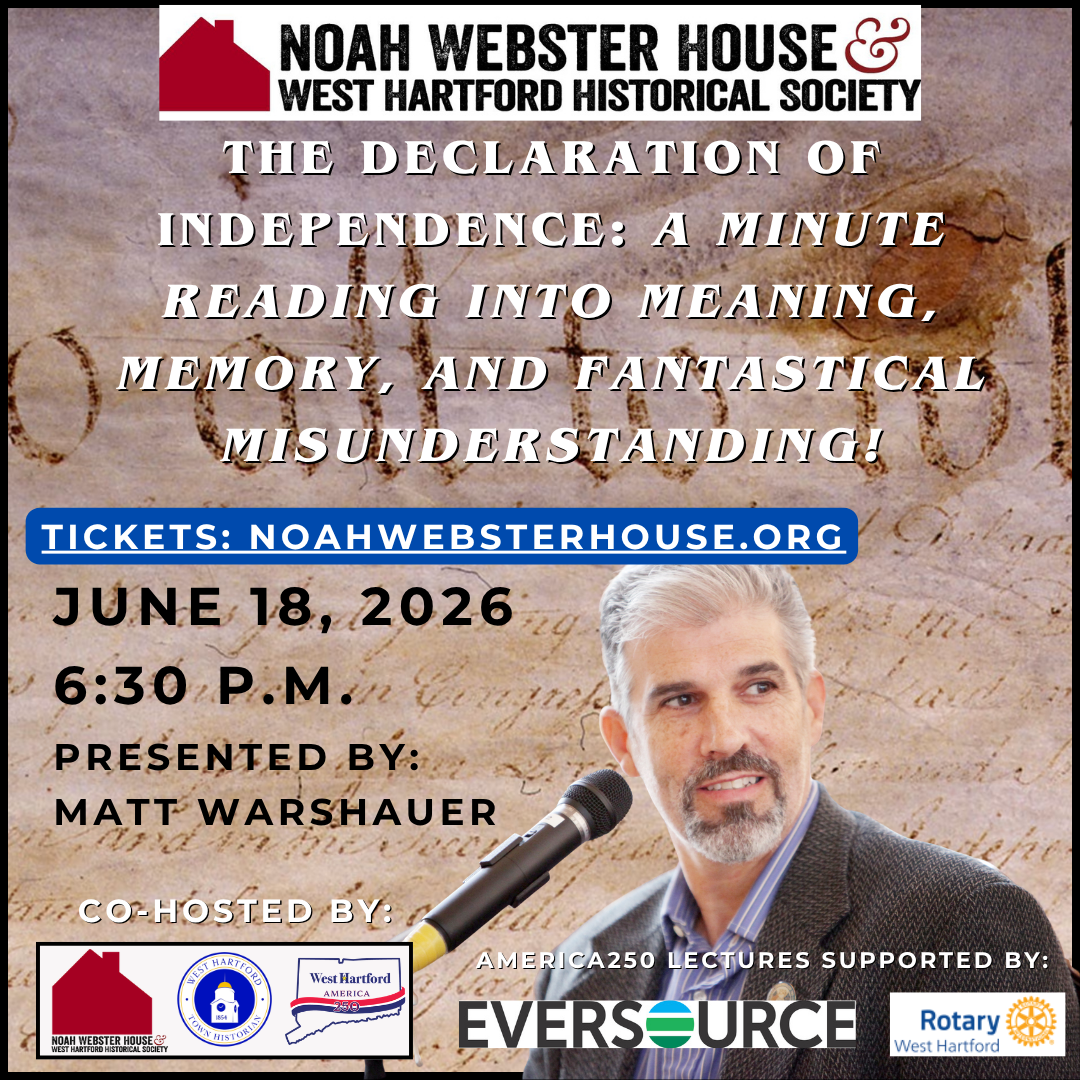
Thursday, June 18, 2026
6:30 p.m.
What did the Declaration actually declare? Why…and to whom? What was the actual point and in the long stretch of history, where does this monumental document stack up in our contemporary world?
Tickets available now at: https://noahwebster.yapsody.com/event/index/857211/americas-first-system-of-government-and-its-utter-failure
This program is co-hosted by the Noah Webster House & West Hartford Historical Society, “West Hartford 250” Committee & the West Hartford Town Historian.
About The Presenter:
Matt Warshauer is a professor of history at Central Connecticut State University, where he received his bachelors in American Studies. Fascinated by what he calls “the American paradox,” the ever-challenging conundrum between the nation’s founding document and the difficulties of pursuing essential ideas of freedom, Warshauer pursued an MA and Ph.D. at Saint Louis University. He has spent the last 30 years exploring the great American experiment in self-government. The author of five books and countless articles and reviews, Warshauer has written extensively on Andrew Jackson, slavery and the Civil War, and, most recently, 9/11 and how the most important and devastating event of the 21st century has impacted the world in which we live. With a unique ability to draw in his audience, Warshauer guides listeners through the complexities of American political and constitutional history so that we can all think more clearly and gain a better of understanding of our role as citizens.
This America250 presentation is supported by Eversource Energy & The Rotary Club of West Hartford.
The Noah Webster House & West Hartford Historical Society is pleased to offer two “America250” themed history presentations for your local library, senior center, history club meeting or social gathering.
Two Presentations To Choose From!
Noah Webster: Patriot Federalist (1758-1791)
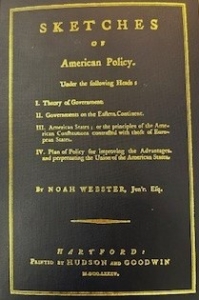
In 1785, Noah Webster published “Sketches of American Policy”, a four-part essay that outlined his vision for a strong federal government, and a call to replace the weak Articles of Confederation, the nation’s first framework for a new government that was formally ratified in 1781.
Webster’s “Sketches” was read by many of the primary architects of the United States Constitution, and it preceded the publication of the Federalist papers by two and a half years.
Considering that Webster’s more famous contemporaries included George Washington, John Adams, Alexander Hamilton, James Madison, Thomas Jefferson, and Benjamin Franklin, the claim of preeminence for Noah Webster, who never fought in any battle of the Revolution, nor held any national office, merits critical examination today.
Dr. Homer Babbidge, former American History professor and past UCONN President, once wrote that Connecticut’s own Noah Webster made it his life’s mission to:
… instill in the hearts and minds of his fellow citizens some of his own passionate love of liberty and to persuade them of the great truth of his life, that liberty could be preserved only through the strength that comes from unity.
Webster’s career… entitles him to an unchallenged eminence in American life, for his broadly conceived ideal of union… surpasses that of his more famous contemporaries.
This presentation will delve into the life and career of Noah Webster as essential to the founding of the American Republic….and will examine what Noah Webster and his extraordinary generation of American Revolutionary leaders overcame to construct & launch this metaphorical vessel known as the “United” States. Its unprecedented design, diverse crew of citizens and uncertain course through an often-turbulent sea of rival nations and hostile peoples was a grand experiment like none other before it.
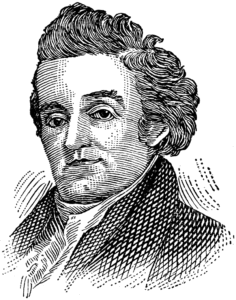
Noah Webster: Partisan Federalist (1792-1843)
In 1789, Noah Webster rejoiced along with his countrymen at the auspicious inauguration of George Washington, America’s first president. Webster wrote to his new brother-in-law to explain that the many months spent as a forceful advocate on behalf of the new Federal Constitution were now over, and he would leave his teaching and political work in Philadelphia to return to Connecticut; once back home, he could practice law, enjoy married life, and raise a family. Noah Webster was only 31 years old.
However, a quiet, private life was not yet possible for Webster, as there was much work left for him to do in service of his country. Daunting as it had been for the Founding Fathers to design a new Federal government that met the approval of citizens in thirteen, very diverse states, the business of governing the nation under the provisions of the new U.S. Constitution would threaten to tear the young nation apart.
All the Framers of the Constitution, (and Webster…whose ideas strongly influenced them) worried that political “factions,” or “parties,” would naturally contest each other for political power and control of national policies enforced by the new Federal government. They anticipated that these factions would appeal to the base of “popular” support and devolve into the kind of social anarchy that was then sweeping across Revolutionary France.
By the time President John Adams assumed office in 1797, those fears were realized. Although Webster spent significant time on his great educational works like the American Dictionary of the English Language, he continued to fully engage in media conflict on behalf of the Federalist Party. The Federalists dominated urban centers and the northeast but were losing influence with the rural districts, as the Democratic-Republican Party coalesced around the leadership of Virginians Thomas Jefferson & James Madison.
The presidential election of 1800 was a vicious contest on both sides but is recognized as our nation’s first “peaceful transfer of power”. When Jefferson defeated Adams, the torch was passed from one political party to another, a promising sign for the future of the republic. Yet, the threat of disunion loomed over America for the remainder of Webster’s life, and he died in 1843 with much trepidation that the American experiment might not endure.
***Please note that Noah Webster & the Rise of Partisan Politics in a Divided America is the second of a two-part lecture series from The Noah Webster House & West Hartford Historical Society. “Part I” lecture of this series is: To Be an American: Noah Webster’s Sketches of American Policy.
How to Book these Presentations!
Contact the Noah Webster House & West Hartford Historical Society at:
E-mail: education@noahwebsterhouse.org
Phone: 860.502.3257
Fee: $250.00
(One-hour public program & brief Q & A…at your location)
Mileage charges at the 2025 Federal Rate of $0.70/mile may apply for travel outside of a 20-mile perimeter from West Hartford, CT., not to exceed $30.00.
Payment: Convenient, fast & secure online payment is now available on the museum’s website at:
https://secure.lglforms.com/form_engine/s/EuyEYdj4By6DHkMYI3vPbA
OR MAIL A Check to the museum at 227 South Main Street, West Hartford, CT.
(Attn: Outreach Lecture)-Payments must be received prior to your scheduled event.
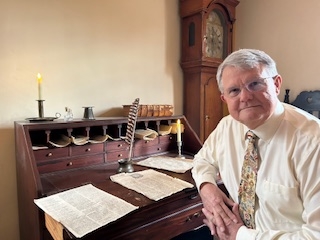
About the Presenter:
Craig Hotchkiss has joined the Noah Webster house team as an education consultant and developed two high school outreach programs and public lectures on the life & legacy of Noah Webster, to coincide with the national, state & local initiatives surrounding the America250 anniversary on July 4, 2026.
Mr. Hotchkiss taught United States History at South Windsor High School for 33 years, including Honors & Advanced Placement classes, and served as the History Department Chair for nearly a decade.
Upon retirement, Craig served as the Education Manager at The Mark Twain House & Museum, where he presented scores of public outreach programs at schools, libraries, and other civic organizations throughout Connecticut and the entire Northeast. Mr. Hotchkiss was also the Site Director for the National Endowment for the Humanities Summer Teacher Workshops at the museum for 5 years and taught a graduate level course Museum Education at Trinity College in Hartford.
About The Noah Webster House:
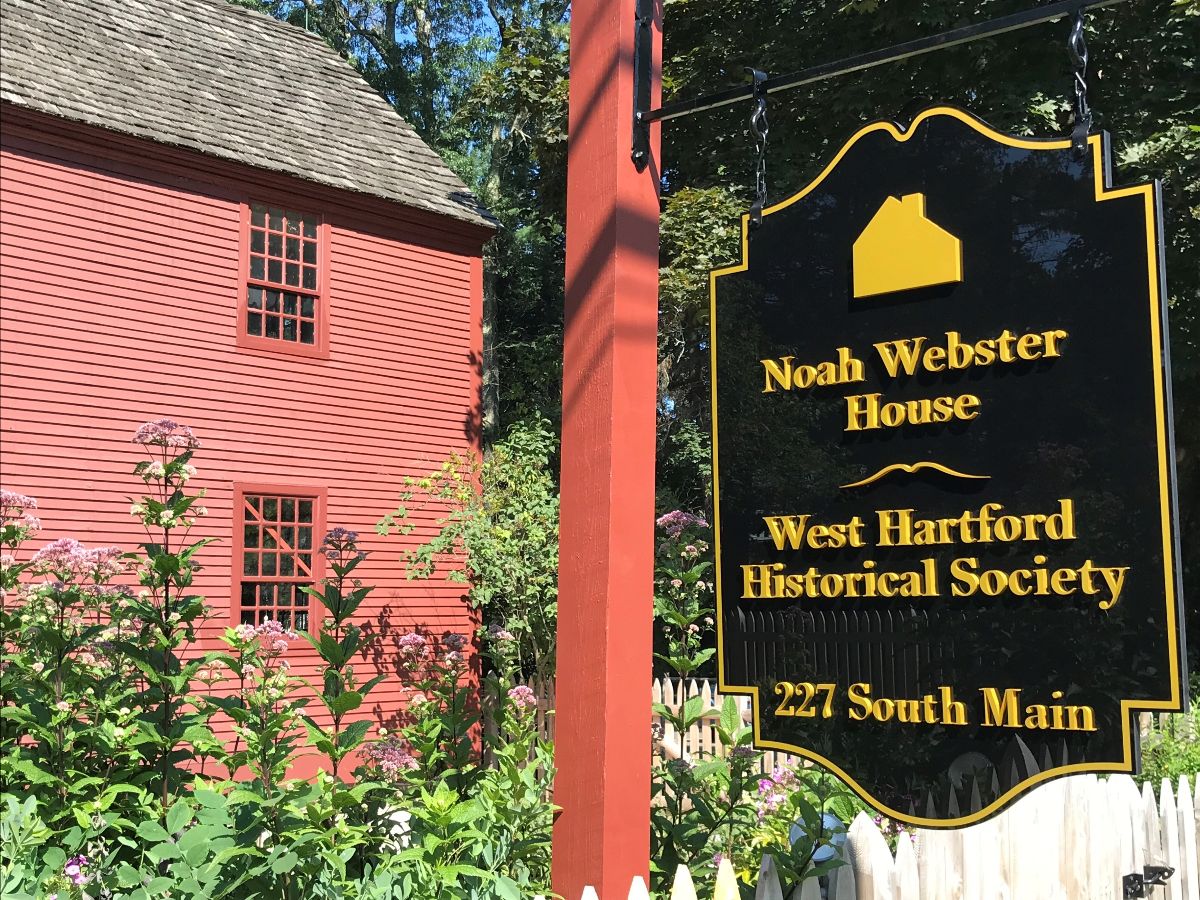
The Noah Webster House & West Hartford Historical Society interprets the life & legacy of Noah Webster; American founding father, educator, author and lexicographer, and preserves his boyhood home (a National Historic Landmark) in West Hartford, Connecticut. The West Hartford Historical Society is a repository of three centuries of artifacts & archives from the town’s storied past. The historic house and exhibit spaces are open for public hours Monday through Saturday, 1:00 p.m.- 4:00 p.m.
For more information, visit our website at noahwebsterhouse.org or call us at: 860-521-5362.
We the People: One Town & the Collective Magic of Its Citizens
October 9, 2025- January 31, 2026
The Noah Webster House & West Hartford Historical Society celebrates the diversity of West Hartford, Connecticut with an America250-themed photography exhibit: We the People: One Town & the Collective Magic of Its Citizens.
Photographer Virginia Kemp presents large-scale portrait photographs, paired with written narratives to capture each person’s life story, their contributions to West Hartford (big and small) and ways in which the town has impacted their lives.
Kemp’s inspiration stems from her propensity “to be drawn to people’s stories”. Growing up in Michigan, she remembers being “the kid who hung on to her grandparents’ every word as they told tales from the past”. Kemp explains that she “loved to sift through old photographs and letters that lived at the family farm….trying to imagine the people and history attached to it all”.
Kemp carried this passion into her early career days as a clinical social worker. After many years and serendipitous turns in life, she’s still interested in connecting with others and the narratives of their lives…through the camera lens.

Join us on October 9, 2025, for an opening reception from 5:00pm-7:00pm at The Noah Webster House & West Hartford Historical Society, 227 South Main Street, West Hartford.
Meet the artist and enjoy wine & light fare!
For more information, call 860.521.5362.
“The Original Promise of America”
2024 Lecture Series
July 18 ~ September 19 ~ November 21
OVERVIEW
This series of lectures will explore how the Revolutionary generation—Noah Webster’s generation—defined the purposes and prospects of their new nation. Noah will make occasional appearances; he played a considerable part in creating a distinctive national culture. But the talks won’t foreground him, nor will they bask in nostalgia for a simpler, more hopeful age. Studies of the past inevitably reflect the present; they can also illuminate paths into the future. While focusing on Revolutionary Americans’ thinking about the promise of the United States in its childhood, we will consider as well how much of their vision has survived, how much ought to be preserved, and why.
THE ORIGINAL PROMISE OF AMERICA: “THE PURSUIT OF HAPPINESS”
July 18, 2024
Many Puritans settled in New England and many Quakers settled in Pennsylvania seeking salvation—eternal happiness in the next world. But these religious folks sought to improve their lives in this world too, as did all other voluntary migrants to British America. Colonists and then Americans avidly pursued the earthly happiness of ensuring they always got enough to eat, of rising in society, above all of owning fertile land in a continent so lavishly stocked with it. Their America was “a place wher [sic] they might have libertie and live comfortably.”
THE ORIGINAL PROMISE OF AMERICA: “LIBERTY”
September 19, 2024
Early Americans universally celebrated liberty. The white men among them probably enjoyed more of it than any other people of their time. Yet even they distrusted liberty so much that they seldom allowed the word to go around unchaperoned. Orators, writers, politicians, and clergymen typically assigned “liberty” an adjectival minder: “ordered liberty,” “rational liberty,” “Christian liberty,” “temperate liberty.” The liberty Americans lauded had no resemblance to individualism, and it had absolutely nothing to do with license. The right kind of liberty was really self-government, “a freedom within bounds” set by laws, founded on property ownership, and ideally guided by virtue. Washington and Franklin, towering model citizens, personified American liberty as it should be.
THE ORIGINAL PROMISE OF AMERICA: “ALL MEN ARE CREATED EQUAL”
July 10, 2025
A few idealists claimed the American republic stood for the equal rights of all humankind. So did a few Revolutionary propagandists, among them the author of the Declaration of Independence.
The truth was otherwise. White men claimed the lion’s share of all that America offered, with little left over for the rest of humanity.
People of color fared the worst. Native Americans received nothing but broken pledges. The new nations promised only bondage to the vast majority of its black residents. By the time of the Revolution, slaves made up 20% of the colonial population. Jefferson and Washington each enslaved hundreds of Black people; even Franklin owned several servants. Nor did any of these great men “remember the ladies” when laying the nation’s foundations, as Abigail Adams famously urged her husband John to do.
But women and Black people knew America was very young and growing fast, a country of the future. From the beginning they claimed larger shares of American promises than their white male masters had ever dreamed of offering them.
__________________________________________________________
About the Presenter: Gene Leach is a long-time resident of West Hartford and taught United States history and American Studies at Trinity College in Hartford until his retirement in 2012. Gene came to Trinity College in 1975 with degrees from Harvard, Michigan, and Yale; at various points in his long tenure, he directed the American Studies Program, chaired the History Department, and directed the graduate programs in both fields. His scholarship has centered on American social thought and this country’s working class. Leach has written, lectured, and served on governing boards for several organizations devoted to Connecticut history and culture—including the West Hartford Historical Society!